This page expands on the GIA or Gigabit Infrastructure Act, a European Regulation including measures to reduce the roll-out costs of telecom networks by focussing on sharing infrastructure and on co-executing civil works.
Read more:
- What is the GIA or Gigabit Infrastructure Act?
- Main definitions in the GIA
- GIA content
- Application of the GIA in Belgium
- Related platforms in Belgium

What is the GIA or Gigabit Infrastructure Act?
The Gigabit Infrastructure Act (GIA) is the European Regulation 2024/1309 on measures to reduce the cost of deploying gigabit electronic communications networks. This Regulation replaces the Broadband Cost Reduction Directive or BCRD (Directive 2014/61/EU) and updates the existing rules to further support the deployment of very high capacity networks (like fibre and 5G).
The GIA is partly applicable since 11 May 2024 and became fully applicable as of 12 November 2025.
The Regulation includes a number of provisions, for instance on the re-use of existing physical infrastructure of operators, utility companies and public authorities (such as ducts, masts, towers, etc.) to deploy high-speed telecom networks. The Regulation also regards the coordination of civil works in all sectors, among which those of telecoms, energy, wastewater, transportation and other industrial sectors involving infrastructure.
The GIA also aims at a faster, simpler and more uniform application of rules within the EU. For example, the GIA also contains rules the applicable permit-granting procedures must comply with, and is strongly committed to making new buildings and buildings undergoing major renovations fibre-ready.
These measures create the terms for a more efficient roll-out of new telecom networks. After all, a very considerable part of expenses for the roll-out of these networks goes to construction works, such as breaking up streets. This Regulation ultimately aims to provide more people in the EU with access to ultrafast Internet.
Consequently, the GIA can be an important tool in the roll-out of fibre networks.
Main definitions in the GIA
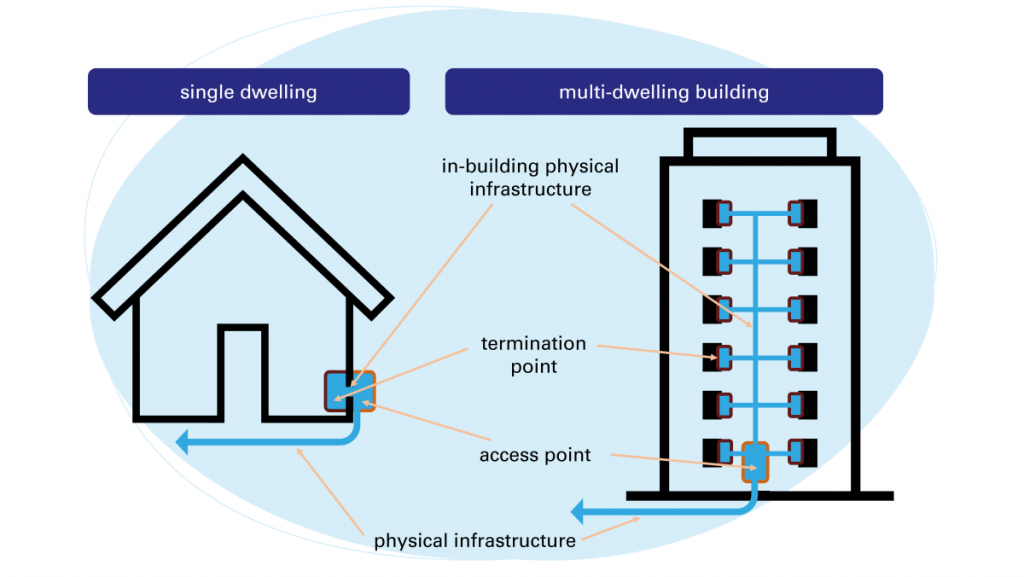
Physical infrastructure: any element of a network that is intended to host other elements of a network without becoming an active element of the network itself (for instance ducts, manholes, masts, street cabinets, etc.). It is important to note that this definition does not include cables, so not the fibre in itself. In addition, physical infrastructure also includes all infrastructure of public authorities, even if it is not part of a network, such as street furniture, street lamps, street signs, bus stops, etc.
Network operator: an undertaking providing communications networks or an associated facility, or an undertaking providing a physical infrastructure intended for, e.g., the distribution of gas or transportation services.
In-building physical infrastructure: physical infrastructure or installations at the end-user's location, intended to host wired and/or wireless access networks (so not the cables as such), where such access networks are capable of connecting the building access point with the network termination point - also see the figure below. The GIA also defines fibre-ready in-building physical infrastructure: it is suitable for hosting fibre.
Access point: a physical point, located inside or outside the building, accessible to undertakings that provide public communications networks, where connection to the (fibre-ready) in-building physical infrastructure is made available - also see the figure below.
GIA content
Broadly speaking, the GIA contains the following elements. These stipulations all apply in the context of the roll-out of very high capacity networks (VHCN), see the page about VHCN for more information.
- Each network operator and public authority has to oblige reasonable requests for access to its infrastructure, coming from an operator wishing to roll-out telecom networks or associated facilities.
- In addition, these operators are entitled to minimum information regarding this infrastructure (location and route, type and current use of the infrastructure, as well as a contact point). This minimum information has to be shared digitally via a single information point.
- On-site surveys should be possible following a reasonable request in order for an operator to assess this infrastructure with a view to deploying a telecom network or an associated facility.
- Each network operator and public authority that owns physical infrastructure is entitled to negotiate with the telecom operators about the coordination of civil works.
- In addition, each network operator and each public authority that owns physical infrastructure is obliged to meet any reasonable request for coordination when carrying out civil works that are at least partially (and indirectly as well) funded by public means.
- In addition, all network operators and public authorities that own physical infrastructure have to share certain minimum information on planned civil works regarding their physical infrastructure, no later than two months before the permit application (location and type of work, the elements of the physical infrastructure concerned, the estimated starting date of the works and their estimated duration, the estimated date of the permit application, as well as a contact point). This minimum information has to be shared digitally via a single information point.
Permit-granting procedures for the deployment of telecom networks and associated facilities should be as consistent as possible across the country. All information on the permit-granting procedure has to be made available via a single information point and it has to be possible to submit and follow up permit applications digitally.
Decisions to grant or refuse permits should be adopted within 4 months. If there is no decision within this period, the permit application will automatically be considered as approved. However, this tacit approval may be waived if the operator:
- can call on or can be invited to meet the permit-granting authority immediately after this period has expired, so that a decision can be taken after all,
- and has the right to obtain compensation or to refer the case to court.
In addition, no permit-granting procedure is required for the construction of telecom networks when it comes to civil works with a limited impact, including small-scale repair and maintenance works or civil works of limited size. However, it is permitted to require a notification.
All new buildings and buildings that are undergoing major renovations must be equipped with a fibre-ready in-building physical infrastructure and in-building fibre cabling.
Moreover, all new and thoroughly renovated multi-dwelling buildings have to be equipped with an access point.
Exemptions from these requirements are possible.
Each Member State must establish concrete technical specifications to be met by the in-building infrastructure and in-building fibre cabling, and ensure that this obligation is complied with.
- Every telecom operator has the right to roll-out its network to the access point;
- Moreover, each telecom operator has the right to access all existing in-building physical infrastructure, if duplication is technically impossible or economically inefficient;
- Any holder of a right to use the access point/the in-building physical infrastructure has to meet all reasonable requests (under fair and non-discriminatory conditions) for access from a telecom operator.
It has to be possible to exercise all rights and obligations in the GIA online, through digital tools. A central national digital access point must also be established per country, streamlining access to all central information points.
A national dispute settlement body shall issue a binding decision on the terms of the conditions of the provisions on access to (in-building) physical infrastructure and the coordination of civil works in case of a dispute.
Application of the GIA in Belgium
Unlike the former BCRD Directive, the GIA is a directly applicable regulation, which means that no transposition into Belgian law is necessary. However, legislation may be needed to ensure the correct application of the GIA. In addition, the GIA provides for a number of provisions to be developed at national level.
The application domain of the GIA is situated at different levels (interfederal, federal and regional).
- At the interfederal level, a new version of a cooperation agreement is being prepared that replaces the Cooperation Agreement of 14 July 2017 between the Federal State, the Communities and the Regions in the context of the transposition of Directive 2014/61/EU, and which established the body for dispute settlement regarding network infrastructures.
- Federal:
- At the federal level the Act of 11 March 2026 on the implementation of Regulation (EU) 2024/1309 of the European Parliament and of the Council of 29 April 2024 on measures to reduce the cost of deploying gigabit electronic communications networks, amending Regulation (EU) 2015/2120 and repealing Directive 2014/61/EU (Gigabit Infrastructure Act) applies.
- The technical specifications that the in-building infrastructure of new and thoroughly renovated buildings must meet are currently being laid down in a royal decree: this website will publish a separate page on this subject when the royal decree is available. The proposal for a royal decree by the BIPT can be consulted on the BIPT website.
- At the regional level, relevant legislation can also be adopted or apply within the areas of competence of each government, such as related to permit-granting policy.
Related platforms in Belgium
The FPS Economy publishes the national digital access point for Belgium, which lists the various central information points that apply to the GIA.
Important central information points are those that contain information about access to physical infrastructure and planned civil works. The provisions in the GIA have been laid down at the European level, but this does not exclude that the Belgian legislation on this subject contains additional provisions.
There is for instance the concept of “working in synergy”, which, contrary to what is described in the GIA, is not only compulsory for network operators performing civil works funded with government means.
In that regard we refer to the platforms used in this context in Belgium, and which usually include a wider scope than laid down in the GIA:
- KLIM-CICC is short for Kabels en Leidingen Informatie Meldpunt – Point de Contact fédéral Information Câbles et Conduites (Federal Cable and Pipeline Management Database).
- KLIP is short for Kabel- en Leidinginformatieportaal (Cable and Pipeline Information Portal) and is a web-based application in the Flemish Region aiming to help prevent excavation damage to cables and pipelines.
- GIPODis short for Generiek Informatieplatform Openbaar Domein (Generic Information Platform Public Domain) and is used in Flanders for the coordination of civil works.
- PoWalCo is short for Plateforme Wallonne de Coordination des chantiers (Walloon coordination platform for building sites) and is used in Wallonia for the coordination of civil works.
- Osirisis used in the Brussels Capital Region for the coordination of construction sites on the public roads.